I have this wonderful daughter of mine,
Who’s love and thoughtfulness is so kind.
Her words and deeds,
Like birds and bees,
Make me smile and beam like sunshine.
I have this wonderful daughter of mine,
Who’s love and thoughtfulness is so kind.
Her words and deeds,
Like birds and bees,
Make me smile and beam like sunshine.
I realise it’s very late but I completely forgot to post this year’s valentine poem to my daughter.
In previous years (Easter Poem, Valentine poem 2013, Valentine poem 2012) I’ve written slightly longer ones but this year I decided to write a shorter one on a piece of paper folded over so that she would read each line one at a time. It was silly and fun but what do kids like more than something that is silly and fun!?
Dear Daughter
You fill my life with joy,
I’m so glad you’re not a boy!
Your laughter and smile
Make my life worthwhile
xxx
Dad
I took two things specifically into consideration when I wrote this:
If you’ve got poems you’ve written for your kids, do share them with me – I’d love some more inspiration and there’s really no need to wait for special occasions to write to your kids!
Thanks to a recent reader question about what techniques are there for making stories interactive, I have a new article to publish for the first time in ages! Thank you whoever you are for asking me and I hope this answers your question (sadly their supplied email address bounced).
Making stories interactive is an interesting topic and one I try hard to do all the time. In the purest sense, you can make your stories interactive by delivering them in an engaging way.
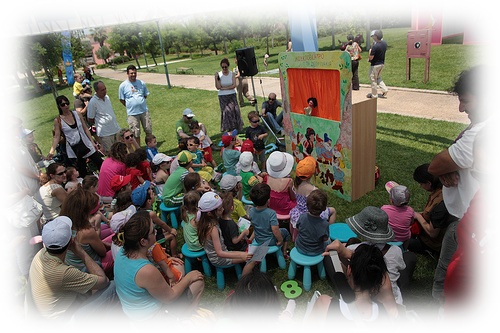
Using facial gestures, tones and moving about, you keep your audience interacting with you: watch their faces, their body language and eyes because they’re telling you that they’re involved (or not) in your story.
If you want to get them physically involved and “interacting” with the story, then check out the following two articles and try out some of the suggestions:
http://kidmunication.com/
This article is all about the concept of story sacks: a “sack” or bag containing props and devices relevant to the story that the children can bring out to use at certain relevant points during the story.
http://kidmunication.com/
Story cubes are effectively picture dice invented by a clever chap in Ireland and which is now doing extremely well which is awesome. Roll the dice and use the pictures to create a story between you. We took some on a family holiday earlier this year and kept us amused and quiet (well, apart from the occasional squeal of delight from my daughter) on the plane on the way out.
Other ways you can get your audience involved:
Apparently my 6 year old daughter has a poor working memory and this is holding her back in her class at school and has the potential to impact her entire schooling career.
At a parent/teacher meeting a little before Christmas, my daughter’s teacher said that she was very much behind the other children in her class. She struggles with group activities and hides behind the abilities of her peers. Finally, she dropped the bomb shell “There may be something wrong with her and we’d like your permission to put her on a watch list”.
WHAT!? Apart from being very unhelpful just to say “there may be something wrong with your daughter” and not to mention that this is the first anyone has mentioned about Olivia having a problem, where’s the help!? Where’s the advice for her parents to help her!?
After I’d had a chance to calm down I did some research and found that it’s actually fairly common and I even noticed some of the struggles I’ve had in my own life may well be caused by a poor working memory which also would explain where Olivia got it from as it’s apparently genetic.
What follows is a parcel of the information I found out when researching the possible problem(s) and what I could help do about it.
Working memory is the kind of mental blank page we use to carry out temporary calculations, ordering and list making in our heads.
Working memory shouldn’t be confused with short term memory (though it does use it and they are related) – Working memory allows us to take what’s in our short term memory and manipulate it (e.g. perform calculations, re-order or in some way modify the items in it).
The following symptoms were suggested on the Parenting Science page on working memory and it was these symptoms that stood out for me with Olivia.
It is worth pointing out that the web pages (see references at the bottom of this article) suggested that working memory deficiencies may be the underlying cause of other things such as:
It is important to point out that poor working memory does not mean the child has a low IQ (phew!). The problem is that it can look like the child has poor IQ because they struggle to learn without special attention and methods geared towards their needs.
Working memory can also be specific to different sensory channels. For example, a child might be fine remembering and replaying the sequence of visual queues, but given the same queues by sound instead of vision and suddenly they can’t remember it at all. This is why, when you’re playing games and doing exercises specifically to develop and train their working memory (see the section at the bottom of this article) it is especially important that you do so using all their sensory channels (visual, auditory and touch at least) .
From what I’ve been reading it seems that working memory may or may not be a fixed thing so lets, for the sake of my sanity and the need to feel like I can do something to help my daughter, assume that it isn’t and that with work and practice we can help her.
There are lots of “brain training” type ideas, games, exercises and programs available and the argument that working memory is fixed is based on the idea that while doing the exercises and games will improve the person’s ability to do that exercise or game; it doesn’t seem to extend into other areas of related brain usage.
let’s put that aside for the time being and focus on the exercises and games that may or may not help, because doing something is sure as anything better than doing nothing!
CogMed is a computerised training system provided by Pearson that claims to help train children who have poor working memory. In my reading, it came up quite a lot and their website and offerings are specifically dedicated to helping children with working memory difficulties.
While reviews are mixed on it’s effectiveness, there is a deal of research and work going in to it and it may be a good avenue to pursue. I may well give them a ring about my daughter and see what we can do and whether I can afford it.
Here are some ideas of games and exercises that I came across or thought of during my research about Olivia’s working memory:
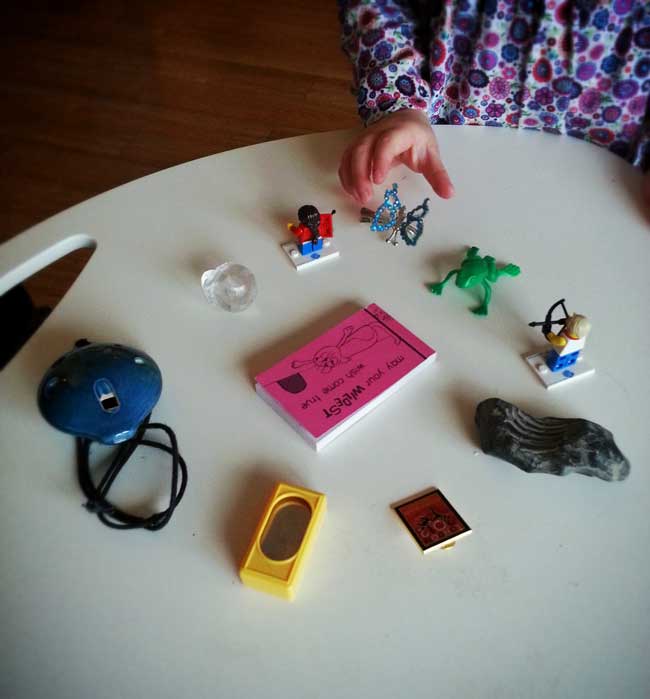
Remember to use all the sensory faculties when helping train their working memory.
One thing I’m particularly bad at is charting and yet it is a very effective motivator for kids. From this day onwards, I hearby declare that I will be creating a big chart for Olivia to show her progress and allow here to earn gold stars.
Since Christmas, O’s school have started extra classes for her and some of her classmates who are likewise behind. It’s actually a great sign that she’s at a good school. We’ve also added (poor sausage) extra maths and english homework to her after class routine as well as weekends. At our parent-teacher meeting in March, her teacher said that she had improved, but that she was merely maintaining her position in relation to the rest of her classmates. That said, several of the other kids have slipped and she’s no longer at the bottom.
It’s hard work for O and for us and I really hope that our perseverance (something that she was also criticised for) pays off for her.
The National Centre for Learning Disabilities has several articles about working memory and the one on helping children with working memory difficulties is one I have used heavily for my research and this article.
The CogMed has lots of stuff about working memory and of course their products, but it is worth a look.
ParentingScience.com had some very interesting stuff and the poor working memory symptom identification points I used above.
I really recommend a good Google on the subject as there are lots of pages out there about it.
As I explained in my Valentine’s poem last year, my Dad was a secret poet and I didn’t find out until after he died so every now and then, I like to do something special for Olivia. Be it drawing a picture and posting it to her or writing and then reading a poem. Below is this year’s attempt at bringing together a game we enjoy playing and referencing places she knows.
It took me an hour to write (on the train from Gravesend to London Waterloo) and I hope it gives you some ideas or the motivation to give it a go yourself. I’m no poet laureate so I hope the effort and personal nature of the poem demonstrates to her that I love her with all my heart.
To Olivia,
From here to the beach at Margate,
(But not stopping there: mustn’t be late!)
Onwards to Paris and further still:
To Italy, Rome and Greece if you will.
On past the place that you love the most:
(that’s Turkey of course and the Turquoise coast)
To Moscow, Berlin and Johannesburg to,
To Canada and Alaska where it’s too cold for you.
To the Moon and back,
And not only that!
Around the Globe, twice
(Or perhaps even thrice!)
To the bottom of the Ocean,
(And that’s a craaazy notion!)
But why all this way?
Why don’t I just say,
I love you how much?

I love you this much.
Dad
Xxx
I should explain that Olivia and I have a little game we play in the car or, thinking about it, pretty much any time where one of us will choose a number and say that they love the other that much.
“Olivia?”
“Yes Daddy?”
“I love you 5!”
“I love you 6!”
etc. etc.
It quickly escalates from there with numbers getting bigger and bigger until we get to physical descriptions of space.
“I love you to Turkey! AND back!” (Olivia has had a couple of holidays there and she has a rough idea of where it is and how long it takes to get there)
Eventually we run out of descriptions of things and go totally abstract:
“I love you chocolate buttons!”
“I love you swings!”
It usually ends in fits of giggles and a big hug (assuming we’re not in the car – that would be dangerous…)
If you’ve written a poem or tale for your kids, do share the story in the comments. I’d love to hear what other parents are making of it.
One of the greatest gifts we can give to our children is that of knowledge and awareness.
Making sure that our children understand how people in our world differ and what causes this is an important trait that any young person can have.
Although this is a staple, not all parents have the ability to teach this to their children without some help and guidance from external sources.
There are many resources that can help parents teach their children about religion. Whether you want to just give a general overview or go into great depths, there is something out there to make sure that you are able to give you child the knowledge.
There are many different ways to approach this conversation, whether you chose to use books, classes or just have the conversation on your own, there is something for you that will help make this conversation as simple as possible.

If you are seeking out assistance from either a book, website or class one of the first and most important things you want to do is research.
You want to make sure that the specific organization you are using is not going to emphasis one religion or, even worse; give your children bigoted or racist opinions. You can always read reviews and testimonials. If you want to make your own opinion, it may be a good idea to review the content before sharing it with your child.
Remember, you want to give your child an overall view on religions and ways they differ from one another, so the last thing you want is to have your child become sectarian.

The Kids book of World Religions by Jennifer Glossop is a great tool for parents explaining religion to a younger group of children (3-9).
The book is well illustrated and takes a light-hearted approach to explaining different types of religious views including Hinduism, Islam, Christianity and Sikhism. Basic information is given on each of these religions (book includes many more).
Information includes basic teaching, sacred places and events, religious leaders and scriptures. The book‘s well- illustrated pages make it exciting for a younger child to follow along.

If your audience is a little older, another great book is One World, Many Religions: The Ways We Worship by Mary Pope Osborne.
This is another book that shows the differences between major religious groups in our world.
The book will introduce six major groups and dedicates an entire chapter to that one group. This is great for any kids between 7 and 10.
There are many different organisations that can provide religious education to children of all ages and certainly in the UK there is a religious awareness built into all state school run curriculum. My daughter has certainly celebrated several different religious festivals in her first two years at school.
If you chose to teach your children about different belief systems and religions yourself, there are a few ground rules you want to follow in order to make sure you are coming across and indifferent and unbiased to the differences.
It may be a good idea to attend some religious services to give your kids a first hand experience of what happens and use the time and place to explain some of the aspects, totems, idols or tenets of the system. The key is to make it a fun outing rather than an enforced trip. I’m planning on taking my daughter to the local Sheikh temple soon and to show her how generous they are the way they provide free food to visitors and to explain some of what they believe and why.
Make sure you’re as open minded and un-biased as possible when explaining and answering questions.
Children often mimic their parents (we are after all their best role models) so of course, if you hold a certain opinion they will surely follow.
It’s also recommended that with younger children you make them aware of what commonalities different religions have. This will help them understand that even though some aspects of faith are different, often times we have views that are alike.
Since religion is such an important subject, it’s important that you are comfortable with how it is being taught to your child. For an older crowd, many community colleges offer believe system classes that are usually open to people that just want to explore and not necessarily obtain a degree.
These are all great options for those wanting to explore with others since they are all classroom environments.

As you are going through the journey of teaching your child about the different types of religions around the world, it’s important to always remember to approach this with an open mind and allow for your child to explore and ask questions about the different types of faith.
However you decide to introduce them, it’s important that you keep an open mind and leave all prior thoughts and opinions out of the conversation.
You want to make sure that your child feels comfortable and is able to ask any questions they want without feeling bad for asking.
Reading children’s stories from books or even reciting them from memory are both excellent ways of sharing stories and making the most of story time but I recently came across a wonderful tool for making story telling a brilliant joint activity for my daughter and me.
I also thought that they’d make excellent Christmas presents for anyone with kids in the 5-10yr old range.
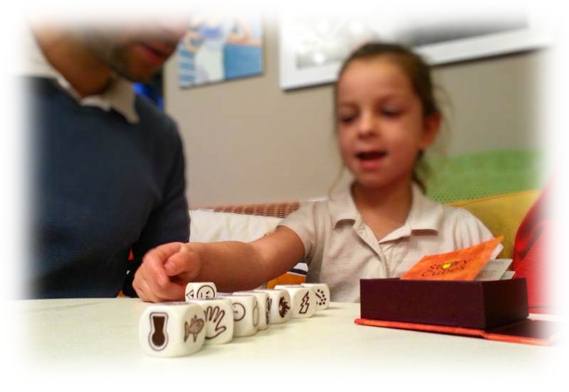
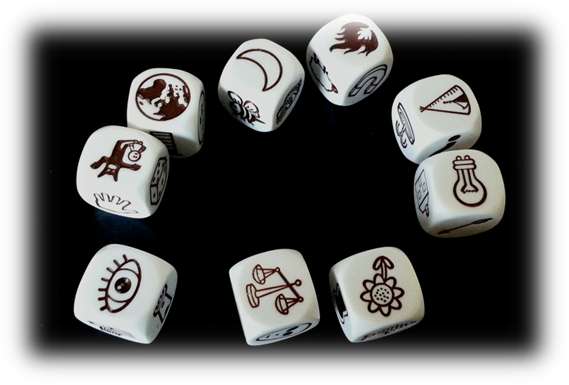
This is my daughter and I creating a story together using the story dice.
Flying back from a business trip to Dublin where I had spent a month working with an insurance company to map their business processes, I had to switch off my iPad for take-off and resorted to picking up the in-flight magazine for the airline.
Flicking through the magazine, I inevitably came across the section for the stuff that you can buy for ridiculous prices while on-board the aircraft. My eye was drawn to a headline piece about an “Irish Success Story” and a whole page dedicated to Rory’s Story Cubes.

I was genuinely really excited! The name of the product and the picture alone told me at once that I should buy some (though I must confess to being a cheapskate and taking a photo with my phone so I would remember to buy them from somewhere cheaper than the aeroplane).
The premise is you have 9 dice each with a different image on each face (making a total of 10 million possible combinations). You roll the dice and start a story with “Once upon a time…” and use the face up images to prompt you with ideas to create a story from scratch.
This will be amazing to share with Olivia! I thought.
A week later and I’m sitting down with O to have a go at creating a story. Now, technically, Story Cubes are for ages 6 and up but O has a great imagination and I was keen to have a go at creating a story with her.
The instructions are plain and simple : tell a story based on the images that come up on the cubes. Every story starts “once upon a time…”
So, I roll a dice and immediately Olivia wants to tell a story about a princess called Olivia…
Fair enough.
The first cube shows a flower, so I start talking about how Princess Olivia was walking in her garden in at the palace among all her favourite flowers…
Now it’s O’s turn to roll a cube, and it comes up with the image of fire. Of course this meant that the flower was on fire and the princess was devastated!
What fun and now we’ve had more practice together using the Story Cubes to create fun stories, she’s starting to get the hang of embellishing the story beyond the short and literal interpretation of the image that is displayed.
What’s great is that she really loves playing with them and it’s something that we do together and not only is she learning how to create and tell a story, but we have a laugh about it and I’m getting to practice shaping the stories we make so that they have a better self-contained structure (ie beginning, middle and end).
For some reason, O and I have taken to rolling one dice at a time and telling the element of the story that corresponds to the image. We end up creating a linear stack of the face up dice along the table and we can look back at the images we used to progress the tale.
So far, we’ve only told stories that last for a single roll of all 9 story dice but there’s nothing to say that we won’t start wrapping around and creating stories that are longer.
This last weekend, Olivia even started adding events and characters outside of the dice and I have a suspicion it won’t be long before we’re wiling away car journey spinning yarns and making up wild and wonderful adventures.
I can’t wait and I can certainly recommend anyone with kids or who has friends with kids to get some of these. Rory has even produced additional sets for different scenarios :
Start your stories with “Far, far away…”
Depictions of verbs allowing real adventure stories to be made. Why not combine it with drawing or acting out the story at the same time
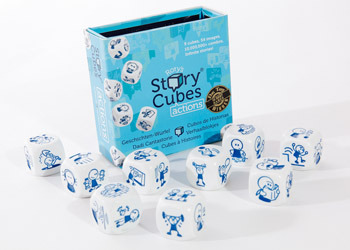
Just before I wrote this article, I rolled the dice and took this photo. What story would you tell from it?
Parents bring children to story time sessions at libraries for many reasons, just as teachers have many different lessons to teach their class through stories and it is absolutely the responsibility of the storyteller or educator to to get the most out of a story through reading or telling techniques.
I argue this point with my business clients as well as friends, family and even people I don’t really know:
In more than one book I have read the definition of effective communication as “The response you receive from the other person as a result of your communication.”
So, how do we make sure that our story time is effective?
Choice of story, sufficient preparation, and enthusiasm make for a great story time for all participants.
Reading stories introduces a plethora of ideas to a child. Also, emotions and thoughts can be (remember that this is entirely at the control of the storyteller) conveyed in easy to understand concepts that helps provide amusement, fascination and fun.
Simply put, telling stories offers a stimulus to a child’s imagination that no other medium can provide.
Imagination must be encouraged to help a child develop into their own person.
Without imagination a child is bound by an environment consisting of only what he can see, hear and touch! This concept sends shudders down my spine at the thought: I imagine it would be much like the experience of those who have been lobotomised.
Telling stories gives a child a chance to unlock a world which has never been seen before, where just about anything is possible.
Imagination enables a child to see vast landscapes, take part in adventures, share people’s life stories and develop a sense of compassion and understanding about the ways in which different people and cultures live.
The best way to provide stimulus for the imagination is to prepare an effective story time and this is accomplished by knowing when to read or tell, knowing your audience and story, using your voice correctly and engaging with the listeners.
When choosing to read or tell there are some things to keep in mind:
Knowing your audience is also key to story choice.
The story choice should be personal to the reader, something the reader can get behind and enjoy telling just as much as the listener enjoys hearing.
However, the age groups of the audience will influence the choice as well.
The voice can also be an effective tool during a story time. Knowing how to change your voice to capture emotion and rhythm can take practice. Knowing your story well will help train the voice to react a certain way when trying to convey different feelings or characters.
However knowing your characters well and the story well will prepare the reader to project the most enthusiasm about the story to the listeners while making it easier to comprehend.
Most importantly, engaging with the audience and treating them as equals will encourage their participation in the story time session.
Each child will take from the session what they are ready to on an individual developmental level, making it fun and entertaining for all is up to the educator.
Happy Storytelling!
I heard about Bloom’s Taxonomy a while ago and I decided to look into it to see how I could apply it to reading stories with my daughter and try to devise ways of helping her develop her cognitive skills.
I am hoping that this article will give you an insight into what Bloom’s Taxonomy is and provide some simple ways you can use it when reading children’s stories with your kids. Essentially, I’m hoping that by the end of this article you will :
Bloom’s Taxonomy is one of the most widely used references in education and, over the years, has even been translated into 22 different languages and is in use around the world.
Psychologist Benjamin S. Bloom was known for contemplating and extensively studying the process of how things worked and this included the process of “thinking”.
He believed that there was specific behaviours that could be noticed and were important in the in the process of learning and in 1956, Bloom’s Taxonomy was created.
There are actually three different domains that make up Bloom’s Taxonomy:
Each domain is then segmented into different levels for educational goals and objectives.
The “Cognitive” domain is what is focused on when helping children learn how to read and think and this is what teachers put a lot of emphasis on in schools.
It is also the focus of this article and, if people would like to know more, I might follow up with the other domains in separate articles (so please do let me know in the comments).
Bloom’s Cognitive domain focuses on the knowledge, comprehension and critical thinking that a child uses or displays during reading time.
Bloom created six different levels of cognitive learning and suggested that each level must be mastered before the child can move onto the next level.
In the 1990’s, a former student of Bloom’s revised the Taxonomy which brought it into the 21st century and it was again updated in 2001.
The only thing altered in the revision is the names of the levels which now look like this:
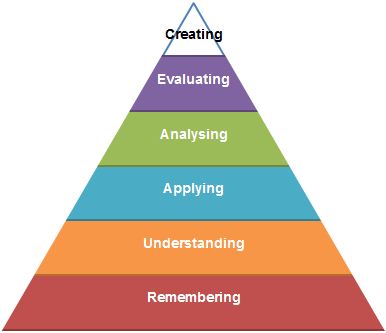
Every child’s critical and cognitive thinking starts with the lowest level and gradually works up to the highest level
There are definite signs that a child shows when they have mastered each level and there are specific questions that you can ask of your kids which will encourage the mental stimulation needed to obtain the next level.
Here is a quick guide for each level that shows the signs a child might exhibit when they have mastered it and example questions that can be asked to encourage mental growth.
By noticing the child’s reactions and answers you will be able to tell when the child has reached a new level in learning and reward accordingly.
To give us a children’s story base line, I am using Little Red Riding Hood as the example book we’re reading. It is important to note that this applies throughout childhood and adolescence and arguably, we never stop developing these levels, so if you have a 4yr old, a 10yr old or even a stroppy teenager, you can and should still apply all of these idea.
In this level the child will be able to recall basic facts about the book through memorising and be able to answer general questions about the book or objects that are in the book.
Help your kids master the remembering level by asking questions like :
If you were reading the Gruffalo for example, you could encourage them to remember the rhythm and rhyme of the story.
At this level, our kids will be able to understand the main idea of the book, recognise characters and organise the facts.
Ask questions such as :
These questions will help your child master understanding of the situation and concepts in the book.
At this level, our kids should be able to show that they can use the knowledge and facts acquired from the book and apply it to other situations.
Ask questions such as :
These kind of how and why and what if questions will encourage your kids to apply what they have learned from other aspects in life equipping them with the ability to do it at any time.
This level encourages the mind of the child to examine the facts of the book, distinguish differences and gather evidence to support what they think.
Questions around the ideas of :
These kind of questions make your child concentrate on the scenario to gather important facts which will lead to a conclusion.
Classroom debates at school are specifically designed to develop this analysis and reasoning ability and having constructive discussions from different positions on a topic is a skill that’s well worth encouraging.
Make a game of it and challenge your kids to argue a counter position to an opinion they hold dear – Why Pop music is a bad influence, or why mobile phones should be banned from use at school for example. Make it fun and tongue-in-cheek (this is very important).
One of the many anti-bullying techniques used in schools in the uk is to have kids arguefroth for and against the motivations of a fictious classroom bully.
In this level the child will learn how to evaluate the evidence that they use to draw their conclusion and justify or defend their opinion on the story.
To encourage the development of this cognitive skill, ask opinion questions such as :
Get your kids to justify their opinion by asking them why they think it was wrong or fair etc.
For older or moore developed kids: ask them whether they think there were any mistakes or assumptions made by the author (or screen writer if discussing a film). Where there any inconsistencies in the opinions or actions of the characters or story?
For those at exam age, these kinds of critical evaluative discussions often take the form of English or Science homework.
In my opinion, this is perhaps the most fun level and because of that I think it’s actually easier than some of the earlier ones.
At this level, our children will be able to gather the information they have learned and create an alternative ending or construct a new scenario for the story.
Encourage the child to write a poem or song from the story or maybe have Little Red Riding Hood on the moon.
It is up to the child’s imagination what they develop from the story because the basis has already been set up through the original story.
—
I just want to point out that while there are 6 levels, it is in fact a sliding scale and kids will develop different skills at different levels at different times, and you will also notice how each level stacks on top: requiring our children to use the skills developed at the lower levels in order to be able to develop the new ones.
As my daughter and I have discovered, there are all sorts of other bonuses from making this part of story time!
We have great little games where I ask question after question until she makes a big dramatic show and goes “Daddy, enough questions!”.
We make up alternative stories from scratch which leads to all sorts of adventures and games. It also gives me a chance to guide the story to deliver other morals or lessons.
Boring books and stories suddenly become more interesting as you explore possible made up back stories to the characters’ and situations and believe me : your kids will come up with some weird and wacky ideas!
—
A good Google session will reveal all sorts of articles and resources on this, but don’t get bogged down with trying to learn all there is to know. The best thing you can do for your kids is to learn a little bit and give it a go with them. If you want a quick reference guide, then chthout this PDF which gives both hints at the kinds of words to be using as well as suggested questions and outcomes to aim for when following the taxonomy.
Whatever you do, enjoy story time. It should be fun and not “work” or a chore or else our kids won’t enjoy it. They’ll soon tell you they’ve had enough!

I met Luke mid way round the Tough Mudder course covered in mud and dressed as Luigi from Mario Brothers. It wasn’t until a month later as I discovered that not only is he a very talented illustrator, but he’s also just written and self-published a children’s book!
Luke’s book, Eric the Dragon (remember your manners), has been illustrated and written by himself from scratch.
I caught up with Luke on a Skype video call earlier this week and asked him a few questions about his book, how he came up with the idea (and why) and how he went about getting it printed and into the hands of parents at a local school open day.
Luke is 20 something, lean and obviously goes to the gym regularly. The view of his office/room that the Skype video call gives me shows a large-ish room with the same Ikea furniture that I have and walls covered in drawings and scribbles from the world of comics and his own imagination.
I get the feeling that he and I are going to get along very well.
After a bit of a catch up and discussion about our respective Mudder experiences and whether we’ve been foolish enough to sign up for another (I’m doing one in July and Luke’s probably doing one in November, so : yes we are foolish enough), we start talking about the book (or books as it turned out).
Luke works part time at a local stationer (handy for discounted pencils and art materials!) and part time producing illustrations for a company in Holland along with a bit of graphic design, in which he has a degree, for companies wanting logos etc.
—
Ben : So tell us about the book.
Luke : So the first book is finished and that’s gone to print and it’s about Eric the Dragon. And the whole series of books is about kids and bite size lessons. Throughout the story [and indeed all the series as Luke showed me], none of the characters are coloured in.
The idea is to get the children to interact with it and get their colouring pencils out. The way I see it, the more interactive it is, the more likely it is they will remember the lessons.
Ben : Did you do the story as well as the illustration?
Luke : Yeah, I’ve done all of it myself. That’s why it took so long to do!
Ben : How long did it take?
Luke : I’ll be honest, the first picture of Eric the Dragon that I drew wasn’t for the book, it was for a T-shirt design.

Ben : So how did Eric get from T-shirt design to the book?
Luke : He was going to be the spear for a load of canvases about three years ago. All about staying young in the head and try to be young and youthful. Life’s a bit too serious sometimes and [Eric] was a split second idea that kind of popped into my head.
Ben : So did [the book] start out being about manners?
Luke : When I put him in the book, I straight away went to “how can I put him in a book? What would be the theme?” It was always going to be for children, but it probably came from my Granddad : My Granddad always used to say to me “manners maketh the man” and in this day and age you’ve got so many kids out there that don’t really get taught and end up as little toe rags. I just thought if I could get the book out to just a handful of children and they learnt something, that’s good.
Ben : Where did you get the inspiration for the books?
Luke : I have a Tips4Tots book [Luke’s own brand for his children’s books which can be found at www.tips4tots.co.uk]. This is where I put everything : Brainstorming, logo ideas… If I start talking about it and people start giving me ideas, then I start putting them in here. It’s nice to look back and see ideas.
A good bit of inspiration came from the Mr Men books. I think that’s what urged me to make them square. I know it’s like a tiny detail but I used to work at Wilkinson’s and we had a stand full of the Mr Men books and it was really cool to see all the Mr Men books lined up on this spiny turnstyle thing and there was something really cool and it made you want to collect them all.
So the idea for the book is each book is going to be colour coded. So the first one’s green and the next one, along the top, will be “Oliver the Crocodile” and the paint splat behind will be a different colour. So they’ll all be colour coded but they’ll keep the same set up. I drew that from the Mr Men books as well. For me the Mr Men books are very popular. Still! So I wanted to mimic that in a way as well.
When I got the first prints I went into Wilkinson’s and propped them up on the shelf just to see how it looked in the environment it’s going to be in and yeah… It worked. I could just imagine a series of books all different colours but all kind of had the same style. It put a big smile on my face. A big smile on my face!
Ben : What kind of research did you do?
Luke : I was very nieve about it. I just jumped in the deep end and said “let’s make a book.” And then I learnt lessons as I came to the obstacles. Like when I came to the printers to get quotes : they were like “we deal in multiples of 24” or something etc. Then I did some test prints and the bleed line wouldn’t set up properly so pages would be cut off and stuff.
I was like a kid : you give ‘em paints and they don’t stand there putting their apron on and stuff, they jump straight in and get involved! I’m still learning now.
I’ve got little nieces and they did my little trials : I’d FaceTime them and show them stuff and they’d give me a response because I branded the series “Tips4Tots”, so anything I did, I put it past those two and they were awesome they just… Ah children’s English is just different at feedback. They’re better at that, very simple : If they don’t like something they say “nah, no” or if they like something then they want it broken down.
It’s my first book and things will change, but I need to keep that child mentality. The artwork, the artwork is very simple : children look at artwork like that. They like it, they like the little details.
I draw all the time and with the book it’s nice to… It’s not just a picture on the computer : I have a book I can hold now. I have a book I can hand to people and like I said : if it works, it works if it doesn’t, at least I’ve tried.
Ben : So if you don’t mind me asking, how much did it cost?
Luke : For the first set of fifteen books for the [school] open day it was just over fifty pounds [about £3.50 per book] and that was a bargain ‘cause I got quotes on line from different companies and online, the cheapest quote I got for the same amount was just shy of two hundred pounds! When I got the quotes back I was like “£200 for 15 books!!?”
I start thinking in the long run like if I want to mass-produce these things… But then shopping around I found a local printers in Nottingham called John E Wright.
Ben : How did you end up promoting your book at a local school?
Luke : It was all from the stationary shop actually, where I work. A teacher kept coming in and I got talking to her and I managed to get a place on this open day. So I went down, set up my stall and promoted my book. The feedback I got was awesome. Really good.
Ben : What sort of feedback have you had so far?
Luke : I was told by one of the teachers [at the school open day] not to use the word “naughty” in my book. That’s apparently not good. I didn’t know that and to me, its… I don’t see a problem with it.
Ben : Wow that’s a classic word! What do they use to describe a naughty child now!?
Luke : She said “You’re not being sensible”. That was one of them. I can’t remember what the other was.
Ben : So what would you do differently for the next one?
Luke : Again, I’m going to wait for the feedback from the first book. The best thing about it this time is that because the layout’s all set up so it’s 7” by 7” squared, so when I do all the artwork and stuff it’s very much… it’ll be faster, which will give me more time to focus on the quality.
Every two page spread I do, I’ll take that to a group of children rather than just rely on my two little nieces just to get feedback.
At the end of the day, I’m not in it to make a load of money. I’d be lying if I said I wasn’t in it to make a bit of money but it would help future projects. I like the idea of… I wouldn’t say “helping children”… but giving them a product that maybe helps them in an area. Not like life changing things, just… I don’t know, if they read the book and colour it in and then parents start hearing their kids saying “please” and “thank you” more then that’s mission accomplished. That’s wicked and that’s what I’m all about. And if children brush their teeth more because they’ve read the second book…
Ben : So what’s next?
Luke : It’s getting super busy at the minute, holding a job down and doing this book and doing all the graphic design and illustration for this company in Holland it’s very hard to find time to… take a bit of time to research more. I’m not on a timeframe and I don’t have anybody saying “this book has to be done by this time”.
Maybe that would be a blessing in disguise because the other companies I work for give me deadlines to get it done and because it needs to get done; it gets done. The book and the other one is on the backburner.
Book number two is Oliver the Crocodile (Look After Your Teeth), teaching kids how to look after their teeth and the third book will be the Big Bear, remember to share. Nothing too deep and then the other ones that are big at the moment like recycling.
The thing that pushed me to really get it done is the teacher who got me a spot at this promotion day the other day. It was a couple of months ago and she said “I’ve spoken to the committee and they want you to come and promote your book.” I was like Wohaa! Right! Two months, so let’s do it! And I spent a lot of time drawing and
Ben : Thanks a lot Luke and good luck!
Luke : It’s been a pleasure and I’ll speak to you in the near future.
—
Luke is working on making online purchases of Eric the Dragon available, but in the mean time, if you’d like a copy, head over to www.tips4tots.co.uk and send him an email and he’ll let you know when the next batch are being printed and what it will cost you for a copy.
